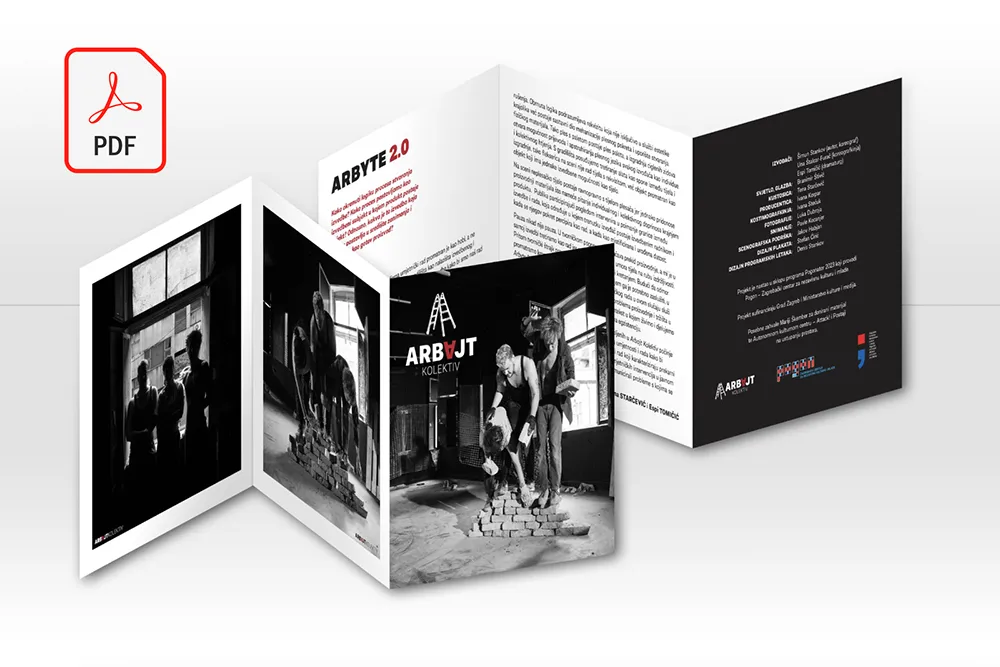
Arbyte 2.0
How can we reverse the logic of the performance creation process? How can we set up the process as a performing subject in which the product becomes an object? That is, what kind of a performance places the process in the center of its interest and treats it as a finished product? How can elements that are a strong symbol of one environment be named as symbols of another? How can we change the state of those elements from passive to active?
In the context of neoliberal capitalism, artistic work is seen as a hobby and not as a job that requires a wage. By taking the construction site as the starting point and source material for the performance and scenography, we use the concept of constructing the performance in order to make our work measurable. In addition, we deal with the idea of sustainability, as we aim to recycle and repurpose objects from the construction site environment. Elements that have a specific purpose and are in a passive state are taken and given a new purpose – in that way, a brick, which finds itself in a completely different registry (it is used in constructing buildings) is now through the process being activated and is given a new value. The brick, as a great symbol of mankind, transforms to a symbol of performance. The scenography thus becomes not only an element in the performance, an active carrier of the choreography, but also an element of the archive.
The question arises, do we observe the stage as a construction site, an abstract factory in which the production of repetitive materials is associated with the mechanization of man producing capital, or is it precisely this repetitiveness that results in a performance. By repetition, on the other hand, we offer less performance material for the recipients, treating it as a rebellion against the social perception of the product as a source of income.
By introducing props from an environment with recognizable measurable work, we offer the audience an insight into the performance, which was built over months of underpaid work – a time spent that isn’t subjected to the laws of economics, making that work invisible.