
Experiments #1:
Public Begging and Swing Scores
Dear Reader,
I’m currently getting my Master’s degree in Performance Practices at ArtEZ University of the Arts in Arnhem. I came to Arnhem after 8 years of professional (and at times extremely fun) rollercoaster of working as a freelance artist in Zagreb, Croatia. From hip hop battles, to contemporary dance, to theater, from house and techno to world music and roots reggae, from the street to the institutional theaters, and back to the street, from dreaming of professional artistic life in a big “cool” (name any of your choice) European city, to “the captain leaves his ship last.” My conflicting nature consists of different layers of social interactions, of underground culture in fashion, music, and visual arts, to the ongoing fascination for human stupidity, destruction, and social inequality.
I don’t know about you, dear Reader, but my inspiration and urgency to create is related to the environment that I live in. It comes from the lived experience, from the things around me. It comes from real experiences, from anger, from the impossibility of a comfortable life, and it comes from the streets, construction sites, and clubs. If we as artists want to problematize something, we need to have a problem, right? My urgency comes from smelly, forgotten spaces, but it also comes from compassion, nostalgia, and a complete and sincere love for the craft of performing, proximity to the audience, and the potential to generate critical opinion (if you are close enough to the problem).
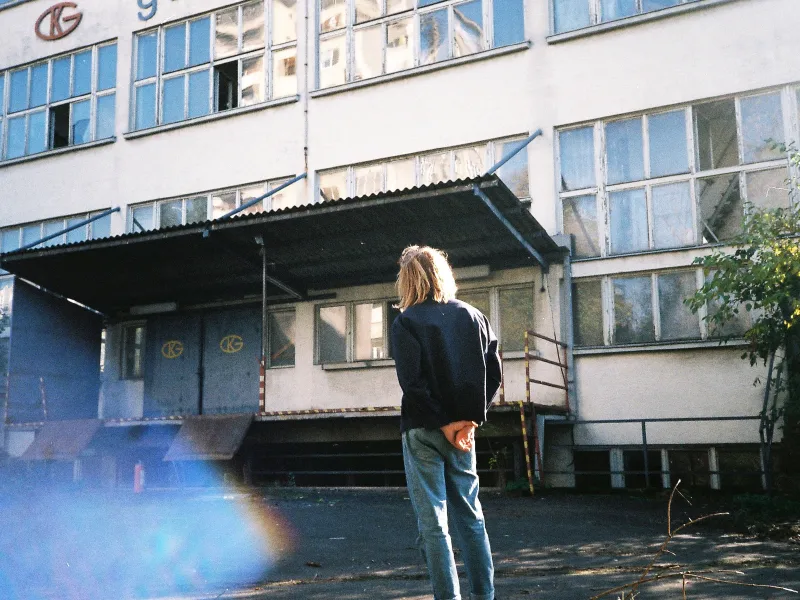
Me in front of my imaginary theater space, decaying factory Grafokarton / Zagreb 2020.
During my studies at ArtEZ, I had lectures with VestAndPage World Politics and On World Politics and Performance: Overcoming structural political boundaries by thinking with the body. Throughout the week, we covered recent topics in world politics through theoretical and short practical assignments. From neoliberal capitalism, climate change, racial and class struggles to our questions related to our artistic work concerning these topics. As students, we are in a safe space of the ArtEZ building, commenting on the important questions around art, politics, and life, and because of that, I felt overwhelmed by the all the possibilities for taking action, and the helplessness and need to get out of the building into the real world. Together with Dora Pocedić and Zorka Marian, I decided to dedicate the last day of class to our attempt to thematize and react to social and financial inequality. We decided to go to Nijmegen and beg for money. We wanted to see if we, as three young, white bodies, would collect more money than a homeless person. In some cities in the Netherlands, begging for money is strictly prohibited. In Nijmegen, we were asked to leave the train station because it is forbidden to beg there, but in the city center is somehow allowed. We agreed that if the amount collected is more than 20 euros, we will donate it to a human rights organisation, and if it is less, we will give it directly to the homless, considering that the three of us are entering a shared space in which technically depriving them of the possibility of earning money.
Our “public begging” performance was fairly simple: we were standing for five hours with the sign and box under our feet. Ironically, after five hours of begging, we managed to collect as much as 70 cents. We received 50 cents, while we found 20 cents on our way back to school.
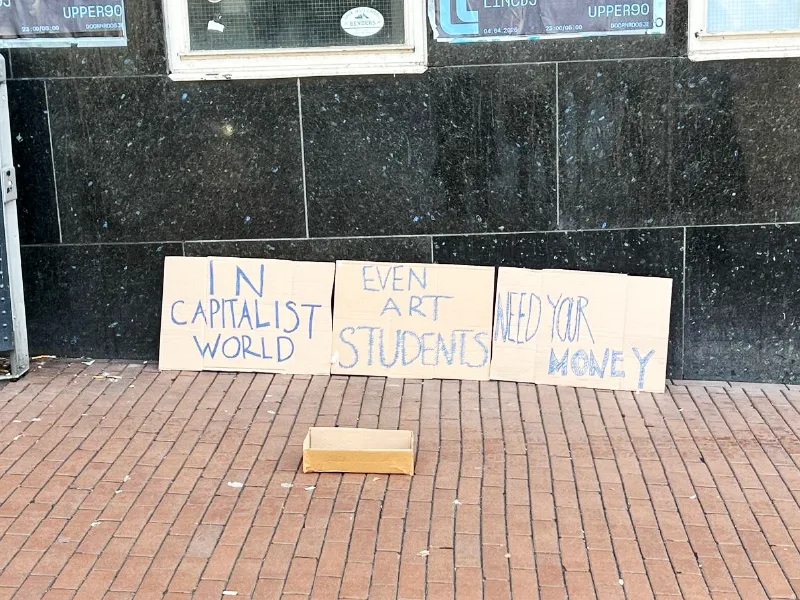
public begging experiment // RISKS:
1. Performance was too simple
3 people with their backs against the wall, silent, almost like a human installation holding a sign.
2. Is it begging or performing?
Given that we deal with the body and the performance, and that we are young professionals in performing arts, any change greater than “standing” would become a performance of begging, that is, begging would become a tool for obtaining performance material. In other words, we would be paid for our work, which is to perform.
3. People are numb to the banners/adverts
Banners and adverts are everywhere: on the streets, on top of the buildings, in trains, trams, and cabs. They come in different shapes and sizes, they pop up on our screens. They are quick, entertaining, and colorful, tricking your subconscious into spending money on platforms that are exploitative and harmful for the environment. Our sign IN CAPITALIST WORLD, EVEN ART STUDENTS NEED YOUR MONEY is an accurate statement, but it is a statement, not a question. If you imagine people walking, to connect the statement with the three of us, and realise that we need money, they are already gone. Or probably stopped reading after IN CAPITALIST WORLD…
Only a cardboard box beneath our feet suggests that we are begging for money.
4. People don’t carry cash anymore
Funny enough, one lady wanted to give us money, but she did not have any cash on her, so she suggested putting a QR code to modernize our street venture. Sadly enough, many people who actually beg on the street don’t have an active bank account, so a QR code is a matter of privilege.
5. Police & Citizens
One of the problems of site-specific work is the potential encounter with angry citizens, or rather, our beloved police. In any case, my experience has taught me that the more “public” and hectic a place is, the more likely it is to run into both types of encounters. In Nijmegen, our begging experiment was interrupted by the arrival of two cops who identified us, and questioned us about our intentions, finally giving us the green light to continue with the experiment. I wonder what would happen if we were art students of color.
THE AFTERMATH: notes on improvement
If I were to start working on this public begging experiment/performance again, I would consider the choreographic potential of this action. Choreography is an overlooked concept outside of theatrical or performance language. One of the most potent and constant choreographies is actually unintentional, conditioned by architecture, public transportation, objects, and other people, underlying social relations and patterns. Every time people use escalators, they engage in social choreography that, if viewed from afar, has its own arrangement, time, and spacing, but it is conditioned by the movement of the escalator, not a director or choreographer.
In a public begging experiment, we were leaning against the wall, our backs followed the horizontal line of the building, and we were not sufficiently visible to the busy passersby. Our performance would benefit if we disrupted the established dynamic of walking on the left or right side of the street. Simply standing against the determined direction of the street could change the way people perceive the gesture, and our sign would be more visible.
Another thing that I would change is the sign itself. As humans, we are bombarded with adverts, billboards, logos, and banners in physical and digital spaces. Special Patrol Group’s second Ad Hack Manifesto claims that advertising is a form of visual and psychological pollution. Advertising, quite literally, begs for our attention, and its main focus is on consuming and spending. Begging and giving money, on the other hand, is a conscious decision often conditioned by the individual’s moral scale. Researcher Dr. Robert Heath has proven that advertising works on a subconscious level; advertising works on us without a high level of attention. On the other hand, to beg successfully on the street, we also need to beg for the attention of the passersby. With the sign, I would keep it simple and more direct: DO YOU HAVE ANY CHANGE? // ART STUDENTS IN NEED OF MONEY // GIVE MONEY, SAVE A STUDENT
Merging the concepts of unconscious and disruption is something that currently interests me in furthering my artistic practice. Disruption is closely tied to destruction, or disturbance. I’m more interested in dislocation and soft interruptions of social choreographies that are determined by our everyday life and the environment. Choreography has the potential to generate an embodied ways of knowing, a set of knowledge that is linked to the space, other people, relationships, objects, and my own body. Sometimes I like to roam around the city, imagining potential new spaces for performances or concerts. I’ve been doing it unconsciously for years, but now I recognize the potential to develop it as a practice, or exercise of imagining. Jonathan Burrows suggested that choreography is a feeling, and the feeling of the body in performance/choreography can be trained and manipulated, the feeling can be changed. That struck me because I believe that spaces have feelings. Or precisely that spaces generate a certain feeling and that they possess inscribed logics for creating performance material. On the picture below, what kind of choreography do you see? Im sure it is different than mine, but both of our choreographies are the right ones.
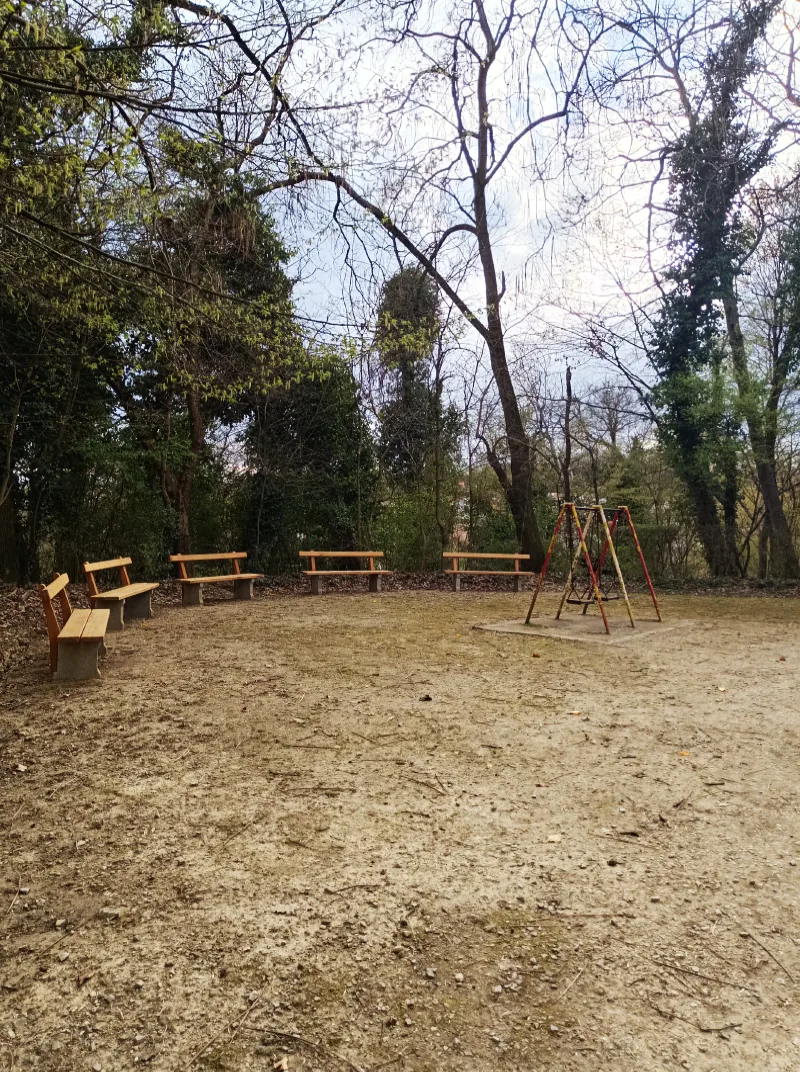
Imaginary concert in Mol for 2 Swings // Zagreb, 2025.
I started to be interested in performance scores, but performance scores are written and affected by the spatial determination of a place/object. Again, see the picture above and write down some qualities that you see, what kind of relationships do you see? How many performers, and how many audience members? What kind of movement do you envision?
I see two performers simultaneously swinging. The swinging consequently makes a sound that is written down as a sequence on a rhythm machine. The movement generates the sound, and the soundtrack generates the choreography.
Dear Reader,
I invite you to observe the entrance of a shopping mall from a distance for half an hour:
- Do you see a choreography?
- What is the rhythm of this choreography?
- Can you distinguish different relationships between people and the space?
- How does a movement relate to another movement, a person to another person?
- What patterns do you see?
- How would you disrupt recognized patterns?
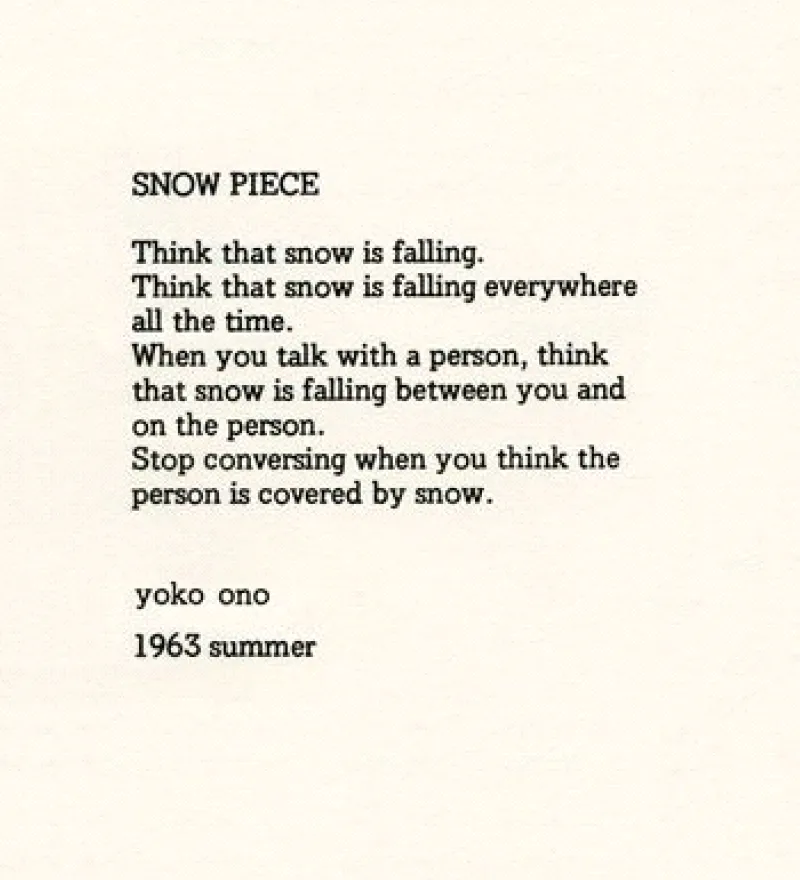
SCORE/SITUATION or DISRUPTIVE POTENTIAL OF ORDINARY THINGS
inspired by Fluxus
- Drive to a roundabout, make five circles around and then drive off
- Walk home only on the sunny side of the street
- Go to a main square and have a picnic with a stranger
- If you see bulky waste on the street, arrange it from the biggest to the smallest
- If you see a pile of bricks on the street, assemble them into a wall